This is an essay I wrote a loooong time ago … I must have been 13 or 14 … good old St. Paul’s Catholic Elementary School in Daytona Beach, FL …
Posts tagged as:
essays
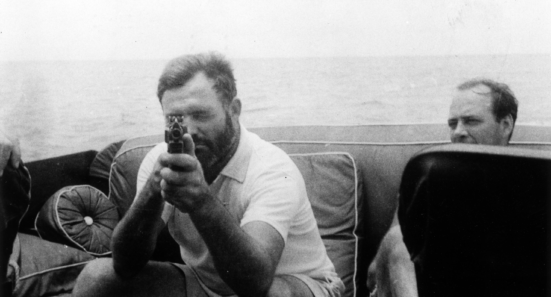
To Have and Have Not
Placing Ernest Hemingway’s To Have and Have Not in the 1930s - an essay by David Gagne
[click to continue...]
{ 4 comments }
Thomas Hardy
On Thomas Hardy’s “The Self-Unseeing” and “The Haunter”
[click to continue...]
{ 13 comments }
Jonathan Edwards and Benjamin Franklin
On Jonathan Edwards’ Resolutions and Benjamin Franklin’s Poor Richard’s Almanacks

{ 3 comments }
Minds, Brains, and Science
“Does John Searle, in his book Minds, Brains, and Science, succeed in explaining how mental phenomena can be nothing over and above neural phenomena and yet be caused by neural activity?” - My Answer.
{ 0 comments }
Sir Gawain
This is from an English lit. class; it was written on February 10, 1993 …
Sir Gawain and the Green Knight
What makes a man a hero? Where lies the line which when crossed changes a mortal man into a legend? Is it at the altar at Canterbury? in the Minotaur’s labyrinth? or is it an age or a time? Does a man become a hero when he transforms from a boy to an adult? or when he stops being a man and becomes a martyr? Where are the heroes of 1993? In whom do the children of this age believe? Like whom do they strive to be? Kennedy, Lennon, and even Superman are dead. World leaders are mockeries of real men, more like Pilates than Thomas Mores. Pop culture’s icons change daily. It is interesting that nearly 600 years ago someone was writing about heroism in a way that can be understood today. The poet of Sir Gawain and the Green Knight tells a tale in which a man is proven to be a hero through the seemingly un-heroic decisions made in the course of numerous tests. Sir Gawain is a hero for the 21st century. He is tried and trapped, he is inundated with opportunities to fail and yet he does not lose. More importantly though, in the end he learns an essential, inescapable fact about himself and human nature.
{ 35 comments }
Meditations on First Philosophy
But if the mere fact that I can produce from my thought the image of something entails that everything which I clearly and distinctly perceive to belong to that thing really does belong to it, is not this a possible basis for another argument to prove the existence of God?
{ 4 comments }
Blake - Urizen
If Blake was not simply stoned out of his mind, then what explanation can there be for this troubling work?
{ 1 comment }
Keats - This Living Hand
You can’t eye can’t I can’t they can’t she can’t he can’t it can’t why can’t why can’t eye don’t no. Y’no? It’s im-poss-ib-al. If there’s one overwhelming iota that I’ve been shown by some auricle at some distant point in my youth, it’s that things that are written are written and things that aren’t aren’t. It’s not fair to me or anyone else (altho to b honest eye don ot really care about anybody else] to say that one thing in the world of written langu-age means anything. These words : certainly don’t mean anything.
{ 0 comments }
Brains and Behavior
Logical behaviorism tries to solve the problem of other minds by showing that behavior is the effect of mind states. By examining behavior closely enough, says the logical behaviorist, it is possible to know mental states of others … In his article “Brains and Behavior” Hilary Putnam attacks the school of thought known as logical behaviorism … Putnam believes that the basic premises of even a weakened form of logical behaviorism can be proven to be false …
{ 3 comments }
Invisible Man by Ralph Ellison
“I got the regular stuff about race and color and pride and prejudice and the sound and the fury and the cultural implications … but what about me?”
{ 3 comments }
The Paradox of Popularity
I took a class in the Fall of ‘94 called Desire and Power in Western Literature. I hated the class and I’m pretty sure the professor, Dr. Snodgrass, didn’t like me very much. I wrote this rambling, terrible excuse for a term paper, in November of that year. It is titled “The Paradox of Popularity: or What does the 1994 MLB strike have to do with being a Tom Petty fan?”
[click to continue...]
{ 1 comment }
Coleridge and Wordsworth
In which I try to, “Discuss the differences in the ways the image of sunset functions in Wordsworth’s Intimations of Immortality and Coleridge’s The Lime-Tree.” (1994)
[click to continue...]
{ 0 comments }
Titus Andronicus
Representations of Gender Ideologies in Shakespeare’s Titus Andronicus
[click to continue...]
{ 1 comment }
Writing Collection
This is a collection of papers, take-home exams, class presentations, essays, fiction, bad poetry, whatever … As much of my writing that I could find on this hard drive …
Enjoy!
[click to continue...]
{ 0 comments }